
February 2026 Market Insights
Market Recap
Market
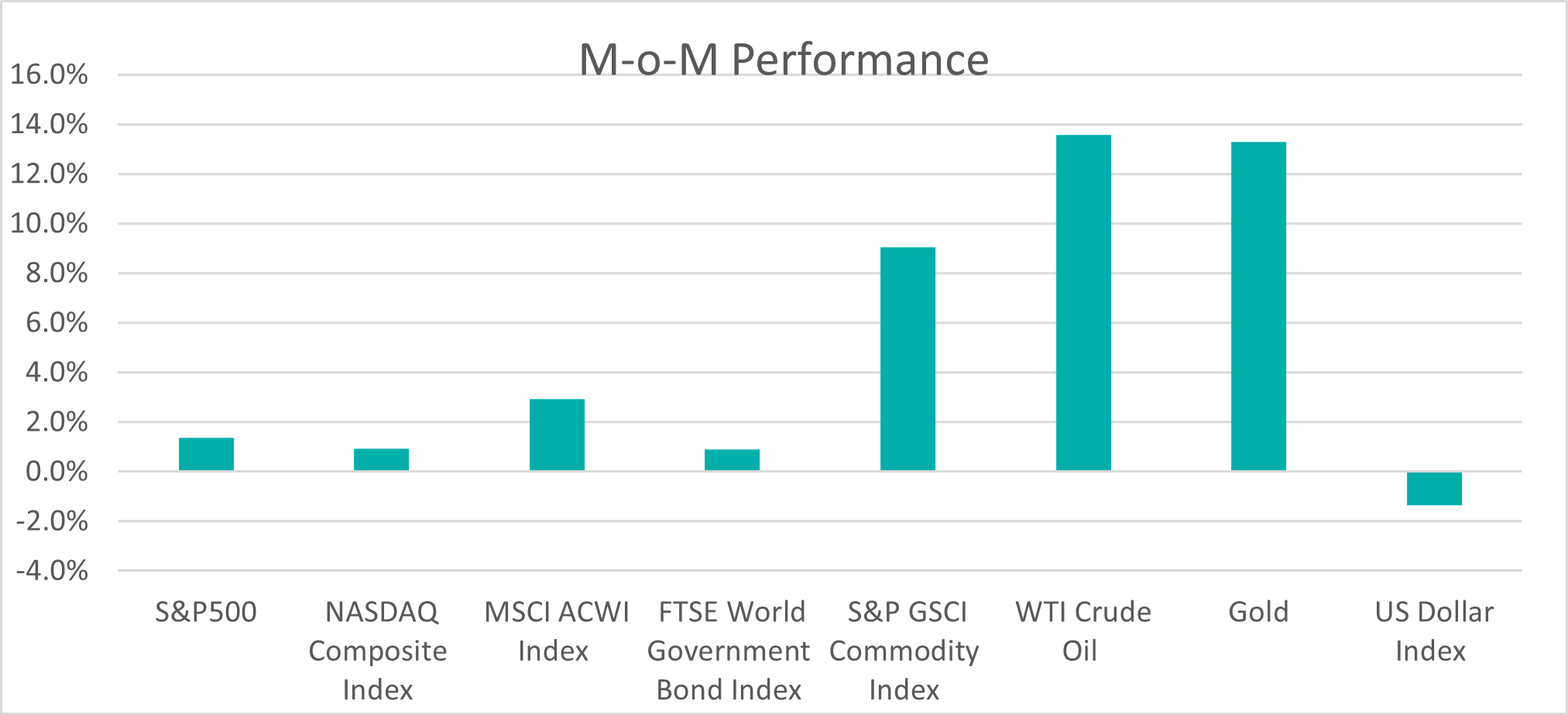
In January 2026, US equities lagged their international counterparts for the second consecutive month with the MSCI All-Country World Index ex‑US rising 5.9% versus the S&P 500’s 1.4%, extending the leadership of foreign markets. This continued a trend where Asia and emerging markets outperformed, while U.S. returns were muted due to concentrated tech weakness. The Nasdaq edged up 0.97%, lagging broader markets as big‑tech weakness and concentrated sector performance held it back.
The 10-year Treasury yield saw a jump to approximately 4.17% to 4.24% in January. This suggests that investors are pricing in a “higher-for-longer” growth environment or are anticipating potential inflationary impacts from future fiscal policies and global trade tariffs. CME FedWatch data indicated a 13% chance of 25bps rate cut at the US Fed’s upcoming 18 March 2026 meeting.
Gold remained the standout hedge against uncertainty, finishing the month with historic gains. The price of gold surpassed the $5,000 per ounce threshold, at one point gaining ~25% in January as investors sought safety amidst tariff threats and concerns over the independence of the US Federal Reserve. WTI crude oil prices jumped by almost $8 per barrel to reach around $67 per barrel, the highest average since September 2025, due to severe winter weather and geopolitical tensions in the Middle East and South America. Bitcoin corrected by 4.9% to $83,895 by end-January as investors rotated out of more speculative assets and into tangible hedges.
The US dollar weakened against the Malaysian Ringgit, ending January-2026 at 3.9453, from 4.0603 in end-December 2025. In 2026, the Malaysian ringgit appreciated by 2.8% against the U.S. dollar.
Outlook
U.S. economic data for January 2026 showed resilient GDP momentum, with late 2025 tracking estimates still pointing to above trend growth despite slight cooling at the margin. However, consumer confidence collapsed to its lowest level since 2014, reflecting deepening concerns about business conditions and future income expectations. The labour market also softened, with economists expecting near zero payroll gains and significant downward revisions to 2025 job creation. Taken together, the data signalled an economy still expanding but increasingly vulnerable to weaker sentiment and slowing hiring.
During its January 28 meeting, the FOMC voted to maintain the federal funds rate at its current range of 3.50% to 3.75%. This decision followed a series of three consecutive interest rate cuts in the latter half of 2025, suggesting that the central bank has entered a “wait-and-see” phase to assess the cumulative effects of its previous easing cycle. The Fed’s statement acknowledged that while inflation has moderated, it remains “somewhat elevated,” and the outlook for growth remains uncertain.
A central theme of January 2026 was the anticipated transition in Federal Reserve leadership. The nomination of Kevin Warsh on January 30 to succeed Jerome Powell as the Chair of the Federal Reserve introduced a significant degree of policy uncertainty.
China’s January 2026 data showed strong export momentum but continued weakness in domestic demand, prompting expectations of additional fiscal support. Seasonal distortions from the upcoming February Chinese New Year also likely softened January readings, with consumption and production typically shifting into the holiday month. Chinese equities remained supported by resilience in “new economy” and AI‑related sectors, even as property‑sector weakness continued to weigh on broader sentiment.
In January 2026, the top performing sectors in the S&P 500 Index were consumer staples, energy and industrials. Conversely, financials, healthcare and technology sectors lagged the broader market. The small-cap Russell 2000 (+5.3%) outperformed the S&P 500 (+1.4%) as investors appeared to be diversifying away from the concentrated growth themes of 2025 in favour of cyclical and value segments that are more sensitive to domestic economic resilience.
Trade tensions between the US and China remained a central focus, particularly in the high-tech sector. While a temporary truce in late 2025 had lowered tariffs on some goods, Washington signalled tougher measures targeting semiconductors and shipping in early 2026. A major legal battle over the president’s authority to impose broad trade sanctions is heading toward the Supreme Court, a ruling that could fundamentally reshape the landscape of global commerce. Another major source of volatility in January was the diplomatic friction caused by the US administration’s pursuit of Greenland and the subsequent threats of tariffs against NATO allies. These developments deepened geopolitical fault lines and the precedent of using broad tariffs as a diplomatic leverage tool remains a key concern for global trade stability.
Elsewhere, we are monitoring the sweeping implications of Artificial Intelligence (AI), with 2026 marking a critical inflection point for companies to translate commitments into tangible financial returns. Views on how AI converts into measurable productivity gains and profits remain divergent. The dramatic escalation of CAPEX spend, coupled with concentrated interdependencies amongst AI companies has investor prompting legitimate concerns on sustainability. The structural case for this space remains compelling, however, investors would be well-served to approach the theme with discipline.
Citation:
https://www.cmegroup.com/markets/interest-rates/cme-fedwatch-tool.html
https://budgetlab.yale.edu/research/state-us-tariffs-november-17-2025
https://www.bbc.com/news/articles/c62n9ynzrdpo
Disclaimer
Kenanga Digital Investing (“KDI”) is licensed by the Securities Commission of Malaysia as a Digital Investment Management Company. KDI is authorised to carry out the business of fund management blending innovative technology into automated portfolio management services offered to clients under a license issued pursuant to Schedule 2 of the Capital Markets Services Act (CMSA) 2007.
Investment involves risk, including the possible loss of capital you invest. Past performance does not indicate future performance. Historical returns, expected returns, and probability projections are provided for informational and illustrative purposes, and may not reflect actual future performance. KDI does not assume any fiduciary responsibility or any liability for any consequences, financial or otherwise, arising from any transaction in reliance on such information. Investors should rely on their own evaluation or consult an independent financial, accounting, tax, legal or other professional advisers to access the merits and risks before investing.
Any forward-looking statements, predictions, projections or forecast on the economy, stock market, bond market or economic trends of the markets contained in this material are subject to the market influences and contingent upon matters outside the control of KDI and therefore may not be realised in the future. No representation is made as to the completeness and adequacy of the information to make an informed decision.
Neither the information, nor any opinion, contained in this article constitutes a promotion, recommendation, solicitation, invitation by KDI or its affiliates to buy or sell any securities, investment schemes or other financial instruments or services, nor shall any security, collective investment scheme, or other financial instruments or services be offered or sold to any person in any jurisdiction in which such offer, solicitation, purchase, or sale would be unlawful under the securities laws of such jurisdiction. This is not intended to be an invitation or offer made to the public to subscribe for any financial product or other transaction.
This information has not been reviewed by the Securities Commission of Malaysia.